"May we have a conversation with you?" Every time we visit a popular site (usually a temple) where there are groups of schoolchildren, we are approached at least once for their "English homework." Once, one of their teachers explained to us that her girls were from a rural area and never had a chance to speak to a native English speaker except on these school trips. So, of course we can't say no. At Tenryu-ji yesterday, 3 giggling girls came up to us as we sat gazing at the bamboo forest (picture). After the usual first few sentences - "What's your name?" "Where are you from?" "Is this your first time in Japan?" this trio began a new sentence and dissolved into laughter, clearly stuck on a word. I asked if I could see the little book from which they were reading. They pointed to the sentence - "We are on a school excursion." "Excursion" was beyond them. So we helped - and they ably practiced -" we are on a school excursion "- completely pleased with themselves. 
 After each of these conversation sessions, we are politely asked if we will pose in a picture with them. So we are memorialized in school notebooks all over Japan by now.

 After each of these conversation sessions, we are politely asked if we will pose in a picture with them. So we are memorialized in school notebooks all over Japan by now.
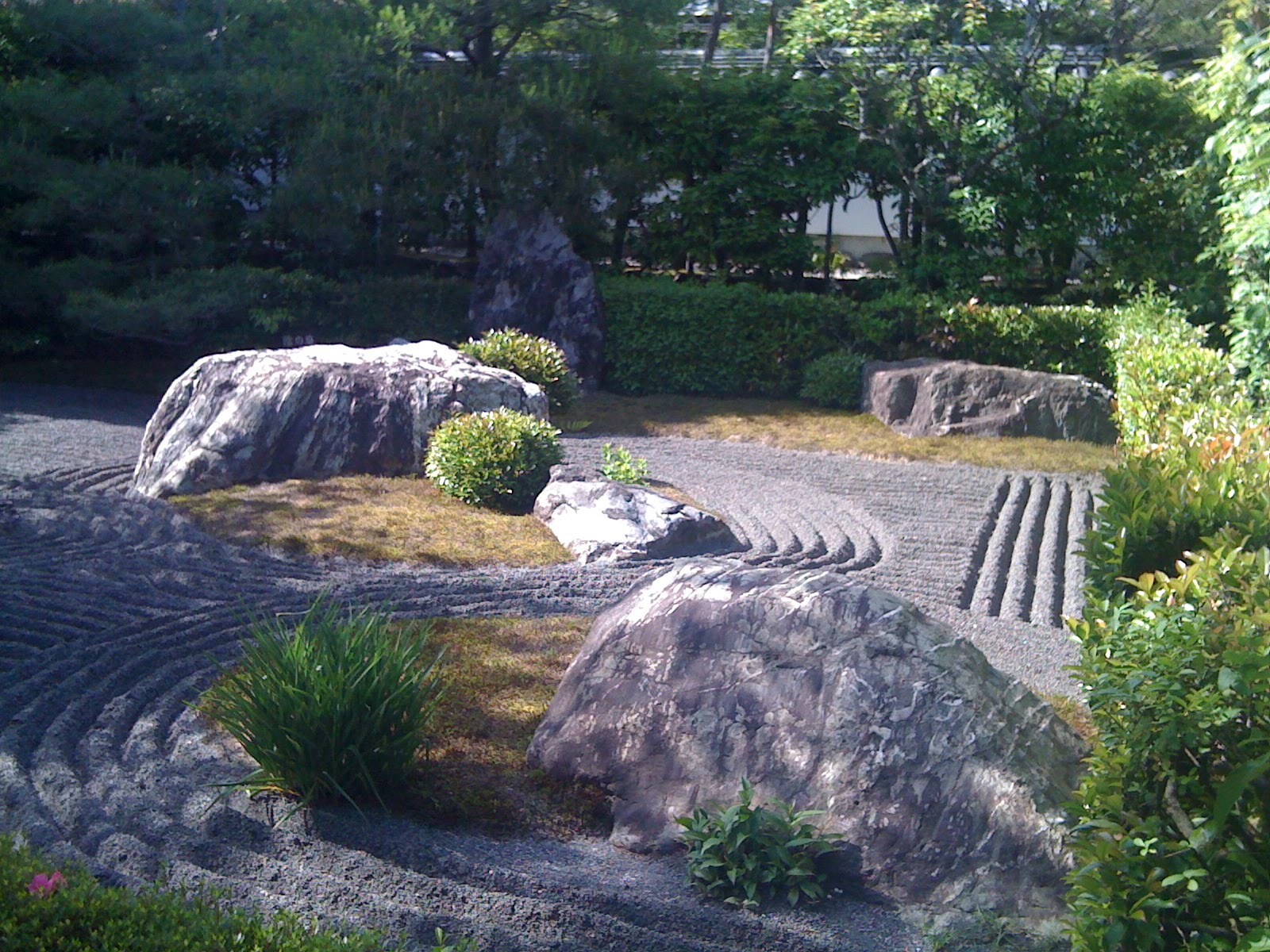
To get to Tenryu-ji ("Temple of the Heavenly Dragon"), we traveled on a funny little train-trolley with a station just up the street from our apartment to Arashiyama, a westernmost part of Kyoto, nestled in the mountains. Once you get off the main tourist strip, it does feel like a charming mountain village. The main temple in Arashiyama is Tenryu-ji, famous for its World Heritage status Sogenchi Garden. The meditation rooms look out on the beautiful strolling garden and we were able to sit and view a piece of the garden as one would do when meditating.


.

A stroll through the garden, which is one of the oldest landscape gardens in Japan, can take an hour and takes you past bamboo forests, which are eerie, seeming to be filled with mist as small yellow leaves fall continually, like a soft rain, and blanket the floor beneath the austere bamboo trunks.
We found this tree, with both red and green leaves, in one of the many sub-temples on the grounds.
Tenryu-ji is part of the Rinzai Zen Buddhist sect and was established in 1339. It was built after a priest had a dream of a dragon arising from a nearby river. The dream was interpreted as a sign that the Emperor's spirit was uneasy, so the temple was built as an appeasement.
After another Zen lunch (more later), we hiked uphill through the village to Adashino Nembutsu-ji, a very weird temple where the abandoned bones of paupers are gathered and more than 8000 stone images are crammed into the temple grounds. Most of the images are weathered away and some have faded red bibs on them, or are marked with small toys or child's things. These are the stones that commemorate dead children.


 Behind the yards full of stone images, we find a stairway up through another bamboo forest. At the top there is a fountain encircled by 6 images of Buddha. Four young men who are also there tell us that if you wash each Buddha in a clockwise manner, your soul will be cleansed. Worth a try!
The walk to and from Adashino took us past a number of other temples and shrines, and past cute shops and places to eat. It definitely began to feel like a mountain village, the air changed, a cool breeze picked up, shadows lengthened and deepened. 
The Zen cuisine philosophy is that most of us "live to eat" but the monks "eat to live." In the Zen monastery, the fundamental act of eating is considered necessary for proper functioning, but nothing else. The meals served at a monastery are carefully planned by a monk holding the important post of tenzo, whose task is to plan meals that will enable everyone to practice Zen with the least hindrance. The daily menu does not vary much. There must be harmony of the 6 basic flavors: bitter, sour, sweet, salty, light, and hot. The monks in training have 2 very basic meals a day and all meals are preceded and followed by verses expressing gratitude. Here's one translation: "First, let us reflect on our own work,/Let us see whence this comes;/Secondly, let us reflect how imperfect our/virtue is, whether we deserve this offering;/Thirdly, what is most essential is to hold/our minds in control and be detached/from the various faults, greed, etc./Fourthly, that this is taken as medicinal/is to keep our bodies in good health;/Fifthly, in order to accomplish the task of/enlightenment, we accept this food."


And now Zen food. We have been in Kyoto for just over 2 weeks and we have already had 3 Zen lunches. Something very strange is happening. Yesterday's lunch was on the grounds of Tenryu-ji, in a lovely setting in the garden, with a pond full of large goldfish.

The Zen cuisine philosophy is that most of us "live to eat" but the monks "eat to live." In the Zen monastery, the fundamental act of eating is considered necessary for proper functioning, but nothing else. The meals served at a monastery are carefully planned by a monk holding the important post of tenzo, whose task is to plan meals that will enable everyone to practice Zen with the least hindrance. The daily menu does not vary much. There must be harmony of the 6 basic flavors: bitter, sour, sweet, salty, light, and hot. The monks in training have 2 very basic meals a day and all meals are preceded and followed by verses expressing gratitude. Here's one translation: "First, let us reflect on our own work,/Let us see whence this comes;/Secondly, let us reflect how imperfect our/virtue is, whether we deserve this offering;/Thirdly, what is most essential is to hold/our minds in control and be detached/from the various faults, greed, etc./Fourthly, that this is taken as medicinal/is to keep our bodies in good health;/Fifthly, in order to accomplish the task of/enlightenment, we accept this food."
For special occasions, the tenzo will prepare a feast--that's what we're getting in these Zen meals. They are completely vegetarian (Buddhist vegetarian cuisine is called shojin ryori) and is surprisingly delicious and filling.


They are often served in these red-lacquered bowls, which you stack together as you finish the many small courses. The monks have their own set of dishes that they rinse with hot water after each meal and, so as not to waste a particle of food and to properly honor all the time and energy expended to grow the food and make the meal, they drink the washing water.
Well, we are obviously addicted to Zen food. Who knew?